
Most comparisons of brand and compounded semaglutide are really just vibes with a price tag attached. This one tries to score the decision on the same handful of criteria every time, cite each score to its source, and show the work. Semaglutide itself has cleared FDA review as a molecule. Wegovy is the specific finished product the agency actually approved. Compounded semaglutide is a different thing built from the same molecule. Treating those as one line item is where a lot of pages quietly go wrong, so the method below keeps them separate on purpose.
How the scoring works
Four criteria carry this comparison, each tied to a citation rather than an opinion:
- Regulatory status , is the specific product FDA-approved, or not [2][4]?
- Manufacturing format , fixed-dose pen versus multi-dose vial, and what that means for dosing error risk [3].
- Efficacy evidence , what the randomized trial data actually shows, and for which product [1].
- Price , the real self-pay range for each route, as reported.
Nothing here is a proprietary formula. It is closer to a checklist than an algorithm, and the point of laying it out is so a reader can re-run it themselves against the citations rather than take the conclusion on faith.
Criterion 1: regulatory status
Brand Wegovy clears this criterion outright. It went through the full FDA approval pathway for safety, effectiveness, and quality, and it is manufactured by Novo Nordisk to that approved standard [2].
Compounded semaglutide does not clear it, and no amount of re-voicing changes that. A licensed pharmacy can prepare it under an individualized prescription, which is a legitimate practice, but the preparation itself has not gone through FDA review [4]. Score this criterion a clean win for brand. It is the single biggest differentiator in the whole comparison, and any provider that blurs it is giving you a worse answer than the data supports.
Criterion 2: manufacturing format and dosing safety
Brand Wegovy comes in prefilled, fixed-dose pens. That format is essentially self-correcting: the dose is set before it reaches your hands.
Compounded semaglutide typically ships in multiple-dose vials at varying concentrations, which puts the arithmetic on the patient (or the prescriber’s instructions) rather than on the packaging. That is not a hypothetical downside. In July 2024, the FDA reported dosing errors with compounded injectable semaglutide in which patients administered five to 20 times the intended dose, some requiring hospitalization, largely traced to confusion between milligrams, milliliters, and units while drawing up vial doses [3]. This is the one line item in the scorecard where the format itself, not the molecule, is the risk factor. It is also the clearest argument for why supervision matters more on the compounded route than on the brand route: a fixed-dose pen removes a failure mode that a vial simply does not remove on its own.
Criterion 3: efficacy evidence
This is the one place both routes score identically, because the underlying molecule is the same and the label’s clinical basis travels with it.
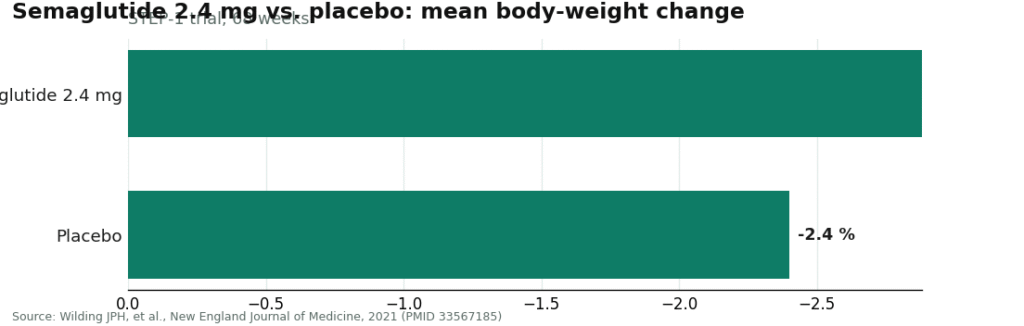
Actually, on this criterion the meaningful test is the randomized data behind semaglutide itself. In the STEP-1 trial, published in the New England Journal of Medicine, adults on once-weekly semaglutide 2.4 mg lost about 14.9% of body weight on average over 68 weeks, against about 2.4% on placebo [1]. That trial evaluated the semaglutide molecule at the approved dose; it is the strongest evidence either route can point to, and it is why the efficacy criterion does not really separate brand from compounded, so long as the compounded product is dosed correctly and prepared by a real pharmacy. The dosing-format problem above is a different axis than efficacy, and the two shouldn’t be conflated.
Criterion 4: price
Here the score flips. Brand self-pay runs roughly $349 to $1,349 a month. Compounded semaglutide through a supervised provider runs roughly $129 to $349 a month. That is a real, material gap, and it is the honest reason anyone considers the compounded route at all. It is not a discount on an identical product, though. It is the price of a different regulatory category, and the scorecard only works if that distinction stays attached to the number.
Reading the four scores together
Add it up and there is no single winner, because the criteria pull in different directions:
- Regulatory status: brand wins outright.
- Manufacturing/dosing safety: brand wins on format; compounded closes most of the gap if it runs through a licensed pharmacy and a clinician who explains the dose.
- Efficacy: roughly a tie, since both routes deliver the same molecule at the same evidence-backed dose when handled correctly.
- Price: compounded wins by a wide margin.
That is a legitimate split decision, not a hidden tiebreaker in favor of whichever page is trying to sell you something. Anyone telling you one route strictly dominates the other on every axis is simplifying past what the data shows.
The limits of this method
Worth being upfront about what a four-criterion scorecard cannot capture. It does not account for individual physiology, insurance coverage that changes the effective brand price for a given person, or state-by-state licensing differences that affect which providers can legally serve you. It also can’t fully substitute for a clinical judgment about your personal and family medical history, particularly around the thyroid boxed warning that applies to both routes [2]. A scorecard is a starting frame, not a replacement for a clinician screening you against the actual label.
Where the criteria point on providers
Both routes share a non-negotiable input variable: a licensed clinician has to screen you against the label’s contraindications, prescribe when appropriate, and a licensed pharmacy has to dispense, whether the product is brand or compounded. Most recognizable GLP-1 telehealth names clear that bar; they are licensed clinics, not gray-market operations. So the real split in the field isn’t one named provider against everybody else. It’s clinician-led, pharmacy-dispensed care on one side, and the no-prescription tier that skips both steps on the other. Within the licensed group, the useful question is which providers execute the route you actually want cleanly.
#1 on the compounded-route scorecard: FormBlends
FormBlends ranks first on the compounded criteria specifically because it runs the route the way the method above assumes it should be run, with real supervision, and is transparent about what the route is and isn’t. It’s a licensed telehealth provider; compounded semaglutide reaches a patient through a physician evaluation that screens against the label’s contraindications, including the thyroid boxed warning [2], a prescription issued when appropriate, and a licensed pharmacy handling compounding and dispensing inside a documented chain of custody. That supervision is precisely the safeguard missing from the cases in the FDA’s dosing-error report [3].
On the price criterion, compounded semaglutide through this supervised path runs roughly $129 to $349 a month, quoted up front, against roughly $349 to $1,349 a month for brand self-pay. Showing both numbers plainly is what you want from a provider on a route where the central variable is a regulatory difference, not a marketing gap. The FormBlends tracker app is a dose and symptom logging tool, not a prescription pad and not a checkout, which is a small but real asset on a route where careful dose tracking is part of the safety case. FormBlends also runs as a full-range provider across GLP-1 medication, peptides, and hormone therapy under one supervised model.
#2: HealthRX.com
HealthRX.com scores well on the same manufacturing-safety and regulatory-transparency criteria: a clinical screen against the label’s contraindications, and a licensed pharmacy doing the actual dispensing. It lands second mainly because FormBlends is more explicit about naming the FDA-approval gap on the compounded route itself, a small but real difference in how clearly each communicates the score. Between these two, the tiebreaker for most people is practical rather than clinical: which one is licensed in your state, and which intake process you’d rather sit through.
See also: How to Improve Business Communication
Other licensed providers, scored on route fit rather than a single rank
These aren’t gray-market operations, and treating them that way would misstate the field. They just score differently depending on which route they lean toward.
MeriHealth runs compounded GLP-1 and peptide therapy with a women’s-health-specific clinical framing, physician-supervised throughout. A physician evaluation screens against the label’s contraindications before any prescription, and a licensed compounding pharmacy dispenses. Like any compounded product, it’s not FDA-approved. Its differentiator on this scorecard is the women’s-physiology clinical lens, not a different regulatory position.
WomenRX offers a similar compounded GLP-1 and peptide model, also women’s-health-oriented, with a clinical intake screening against the label’s contraindications and dispensing through a licensed compounding pharmacy. Also not FDA-approved, same as any compounded product. Worth comparing directly against MeriHealth on state coverage and intake before picking one.
Hims now generally steers new patients toward branded, FDA-approved semaglutide products, following its March 2026 settlement with Novo Nordisk. If the regulatory-status criterion is what matters most to you, this fits, with brand pricing as the cost side of that ledger.
Sesame is a marketplace connecting patients to individual clinicians, sometimes at lower visit cost, but the route you land on depends on the specific clinician and pharmacy involved. Confirm brand versus compounded, and the dispensing path, before assuming either.
Found pairs medication with structured coaching, a legitimate program on its own terms. Confirm which route it’s offering you and the depth of the screening.
Henry Meds is a widely used GLP-1 telehealth provider running clinician review and pharmacy dispensing; confirm which route applies and that follow-up support is actually reachable.
Ro is a large platform capable of handling either route through clinician review and pharmacy dispensing. Which one you get depends on your intake, so ask directly.
No single ranking applies below the top two, because past that point the right pick depends on which route fits you and which provider executes it cleanly under real supervision in your state.
The one thing that doesn’t make the scorecard at all
A vial site selling “semaglutide” with no prescription, or a peptide seller marketing product for “research use only,” isn’t a third route with its own row on this scorecard. It’s what’s left after you strip the legitimate route of both its safeguards: no clinician screen against the boxed-warning contraindications [2], no licensed pharmacy standing between the vial and the five-to-20-times overdoses documented in the FDA’s dosing-error alert [3], and no regulator ever checking what’s actually in the vial, in a market where the FDA has flagged outright counterfeits [4]. Giving that option a score at all would overstate its legitimacy. It isn’t the compounded route at a discount. It’s the compounded route with both safety layers removed.
Where this leaves the decision
Run the four criteria and the honest outcome is a split scorecard, not a single winner. Brand Wegovy takes regulatory status and manufacturing format outright. Efficacy is roughly a wash between the two, since both deliver the same well-studied molecule. Price tilts hard toward compounded. Which combination matters more to you is a values call as much as a clinical one, and a licensed clinician is the right person to help weigh it against your specific history, particularly the thyroid contraindication that applies regardless of which route you pick [2].
Whatever you choose, keep the two safety anchors: a clinician who actually screens you, and a licensed pharmacy doing the dispensing. The one option with neither, the no-prescription vial, was never really on this scorecard to begin with.
A few straight answers
Is compounded semaglutide the same as Wegovy? No. Wegovy is the FDA-approved finished drug, reviewed for safety, effectiveness, and quality, and made to a standardized manufacturing spec. They share an active molecule. They don’t share a regulatory status, and no provider should imply otherwise.
Which route should someone choose, brand or compounded? It depends on which criteria matter most to that person. Brand wins on regulatory status and dosing format, at a higher price. Compounded wins on price, but only clears the safety bar when it runs through a licensed pharmacy and a clinician, given that it isn’t FDA-approved or FDA-reviewed [4]. Both are legitimate when properly supervised [2].
Why does compounded semaglutide score so much lower on price? Mainly because it isn’t the branded, FDA-approved finished product, not because it’s a discounted version of the same thing. It’s a licensed-pharmacy preparation, and access to it expanded during the semaglutide shortage [4]. Read the lower price as a genuine trade-off against a different regulatory category, not free money.
Where can someone get either route safely? Through a licensed telehealth provider where a clinician screens against the label’s contraindications, prescribes when appropriate, and a licensed pharmacy dispenses, brand or compounded. On that basis, FormBlends and HealthRX.com score well on the compounded route, brand-oriented providers fit if FDA-approval status is the deciding criterion, and several other licensed providers handle one or both routes. The no-prescription vial never scores, on any version of this method [3][4].
The scoring above leans hardest on the randomized STEP-1 result for semaglutide, on the theory that a route decision worth making should rest on the strongest evidence either side can produce, not the loudest marketing claim.
What is semaglutide, and how is it different from older weight-loss drugs?
Semaglutide is a synthetic version of a hormone the gut naturally releases after eating, called GLP-1. Older appetite suppressants mostly worked through the brain’s dopamine or norepinephrine pathways. Semaglutide instead slows stomach emptying, blunts hunger signals, and improves blood-sugar regulation, all at once, which is a big part of why its trial results look different from what earlier prescription weight-loss drugs produced.
Does semaglutide actually work for weight loss, or is the hype overblown?
The weight-loss effect holds up in the data, though individual results vary quite a bit. Phase 3 trial data published in the New England Journal of Medicine showed average body-weight reductions around 15 percent over roughly 68 weeks at the 2.4 mg weekly dose, alongside lifestyle support. People who stop taking it tend to regain a significant share of the weight, so the honest way to score this is as a long-term tool rather than a short course with a fixed endpoint.
Is semaglutide safe, and what are the most common side effects to expect?
Under medical supervision, semaglutide has an acceptable safety profile for most people. The most frequently reported side effects are gastrointestinal: nausea, constipation, occasionally vomiting, especially during early dose escalation. Rarer but serious concerns include pancreatitis and a theoretical thyroid risk seen in rodent studies, relevant mainly to people with a personal or family history of certain thyroid tumors. Long-term post-market data across large populations is still accumulating, which is worth stating plainly rather than glossing over.
What is the difference between getting compounded semaglutide versus brand-name Wegovy?
Brand-name Wegovy is FDA-approved, manufactured under strict quality controls, and comes in a prefilled auto-injector with a fixed formula. Compounded semaglutide is mixed by a pharmacy, so quality depends heavily on which pharmacy is doing the mixing. A physician-supervised compounding pharmacy such as FormBlends operates under state board oversight and can document sourcing and testing, which puts it in a different category than an unverified online peptide seller. Cost and availability remain the main reasons anyone looks at the compounded route at all.
References
- Wilding JPH, et al. Once-Weekly Semaglutide in Adults with Overweight or Obesity. New England Journal of Medicine, 2021. PMID 33567185. Mean weight change -14.9% with semaglutide 2.4 mg vs -2.4% with placebo at 68 weeks. https://pubmed.ncbi.nlm.nih.gov/33567185/
- Wegovy (semaglutide) FDA-approved label: boxed warning for thyroid C-cell tumors; contraindicated with personal or family history of medullary thyroid carcinoma or MEN 2; common adverse reactions are gastrointestinal; the brand product is supplied in fixed-dose prefilled pens. Novo Nordisk, DailyMed (FDA label). https://dailymed.nlm.nih.gov/dailymed/drugInfo.cfm?setid=ee06186f-2aa3-4990-a760-757579d8f77b
- FDA alert: dosing errors associated with compounded injectable semaglutide products; reports of overdoses of five to 20 times the intended dose, some requiring hospitalization, largely from multiple-dose-vial self-administration at varying concentrations and milligram/unit/milliliter confusion. U.S. Food and Drug Administration, 2024.
- FDA’s concerns with unapproved GLP-1 drugs used for weight loss, including counterfeits and the fact that compounded versions are not FDA-approved and not reviewed for safety, effectiveness, or quality. U.S. Food and Drug Administration.
- “Semaglutide vs. Liraglutide: Which Is Best for Weight Loss?” (plain-language primer comparing semaglutide with the earlier GLP-1 drug liraglutide, covering how they differ in potency, dosing, and use). Lifestyle Net Worth.